Aug 20, 2026
Fall in Yellowstone - Autumn in the Rockies
Plan your fall visit to Yellowstone. Witness the dramatic elk rut, see Yellowstone's fall foliage, and experience the park with fewer crowds. Book a tour today!
Read More
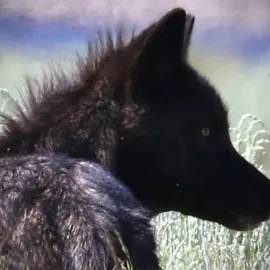
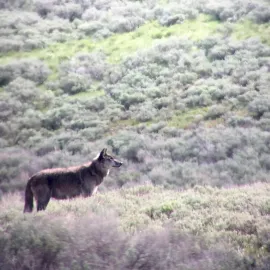
Winter wolf watching is in full swing in Yellowstone. There is no better place in the world to see wild wolves, and watchers have recently enjoyed some very exciting observations of these elusive predators. Our guided wolf tours allow our guests to witness the winter wilderness of Yellowstone. We have the experience, knowledge of the terrain, and local contacts in the park. You can go yourself to look for wolves; however, you will definitely have a better chance of seeing them (and learning about them) if you go with a naturalist guide. Seeing wolves, of course, is never guaranteed, but here is a 2025-2026 Yellowstone Wolf Update to help….
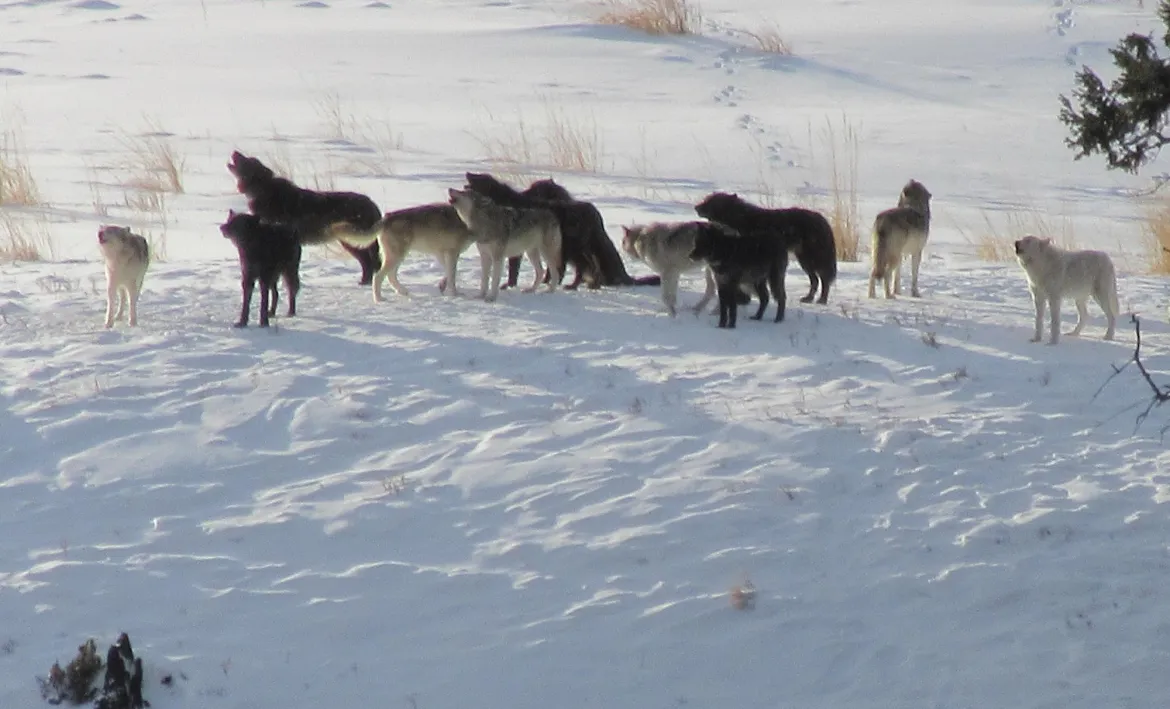
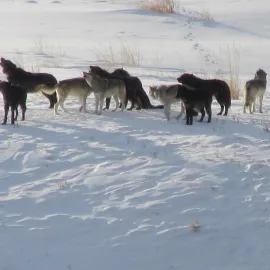
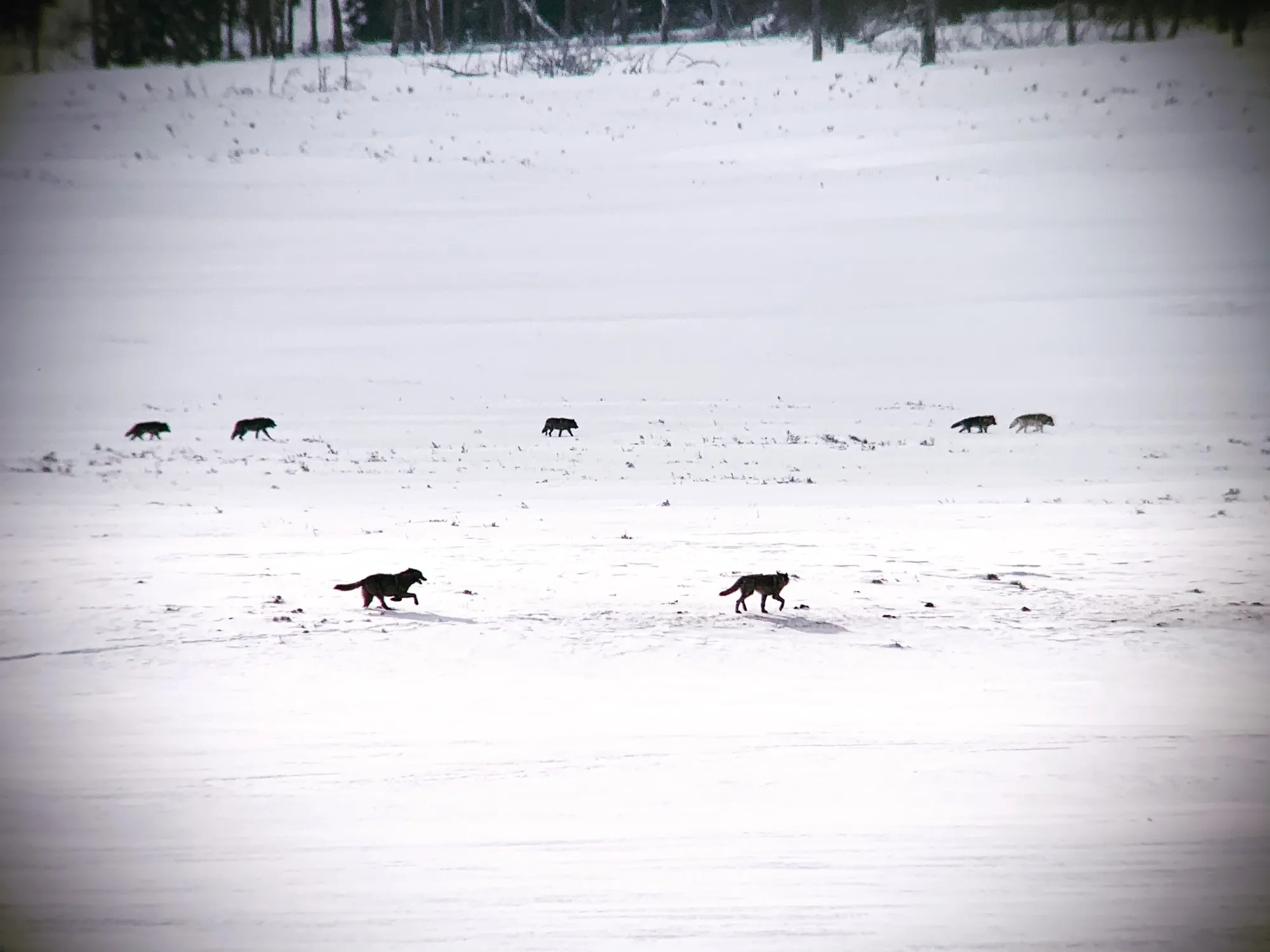
This winter, 2025-26, wolf watching has been steady despite the mainly low numbers of wolves – there are fewer than 84 in the whole of Yellowstone Park. The lighter snowpack has kept prey animals such as elk and bison from descending to the park’s lower elevations. The wolves haven’t had to travel too far for food and resources, enabling visitors to see the Junction Butte Pack or the Rescue Creek Pack with greater frequency.
Book Your Private Wolf Watching Trip in Yellowstone
It’s coming up on breeding season for wolves – late January and all through February. Wolves can have large litters up to 8 pups, so hopefully the breeding season will be a big success, and we will see all of the packs grow. The Junction Butte Pack traditionally den and have their pups at Slough Creek. Slough Creek wolf sightings are common throughout the seasons. But don’t expect to see any pups out of the den until at least late May. The Rescue Creek Pack often den on the Blacktail Plateau, and the Wapiti Lake wolves usually den in Hayden Valley, either east or west of the road.
Some of the first questions I often get on a tour are: Will we see any wolves? How many wolves are there? And how many packs? Is the Lamar Valley the best place to look for wolves? Here’s an update on the current Yellowstone wolf packs for 2026, to the best of our knowledge, as of this writing. An official wolf watching report will be released in March 2026. The numbers refer to radio collars on wolves, and the F or M is for Female or Male.
Of course, a private guided wildlife tour will give you the best chance to see wolves in Yellowstone. However, if going it alone, you will need good winter clothing and a reliable vehicle with snow tires. You can drive the road from the North Entrance at Gardiner to Mammoth Hot Springs to Tower Junction, Lamar Valley, and Cooke City, Montana, where the roads end in winter. Wolves are often seen in Lamar Valley, but other locations can be equally good – Blacktail Plateau, Hellroaring Overlook, Elk Creek, Tower Junction, Little America, and Slough Creek, as well as Soda Butte Valley and Round Prairie.
Book A Winter Wolf and Wildlife Tour in Yellowstone
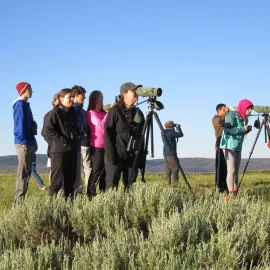
A spotting scope and tripod are essential, and for photography, plan on the biggest lens you can afford and a good tripod. A phone mount for your scope can also work well for photography and video. Digiscoping wolves does make for a quality video. Good binoculars are also important – I use them to scan the landscape for wildlife, then try to zoom in with the scope. If the animals are moving quickly, it is better to follow them with binoculars than to try to track them with a scope. Wait until they slow down or settle for that. Seeing wolves in Yellowstone is often more likely than photographing wolves in the park. The best lens for Yellowstone wolf photography is the biggest one you own.
Of course, you can watch for folks parked along the road with scopes and cameras set up. Check which way they are looking. Find a parking place – often challenging as there are far fewer parking spots in winter. When the Lamar Valley wolves are in view, parking can become a little chaotic. Be careful parking so you do not get stuck and don’t block the road. Get out and look for yourself to see if you can find what people are seeing. If not, then ask around; most people are happy to share information and maybe give you a look through their scope. Also listen if it is quiet – wolves are very vocal and often howl repeatedly. It’s an unforgettable sound, and you will know immediately it’s a wolf or wolves.
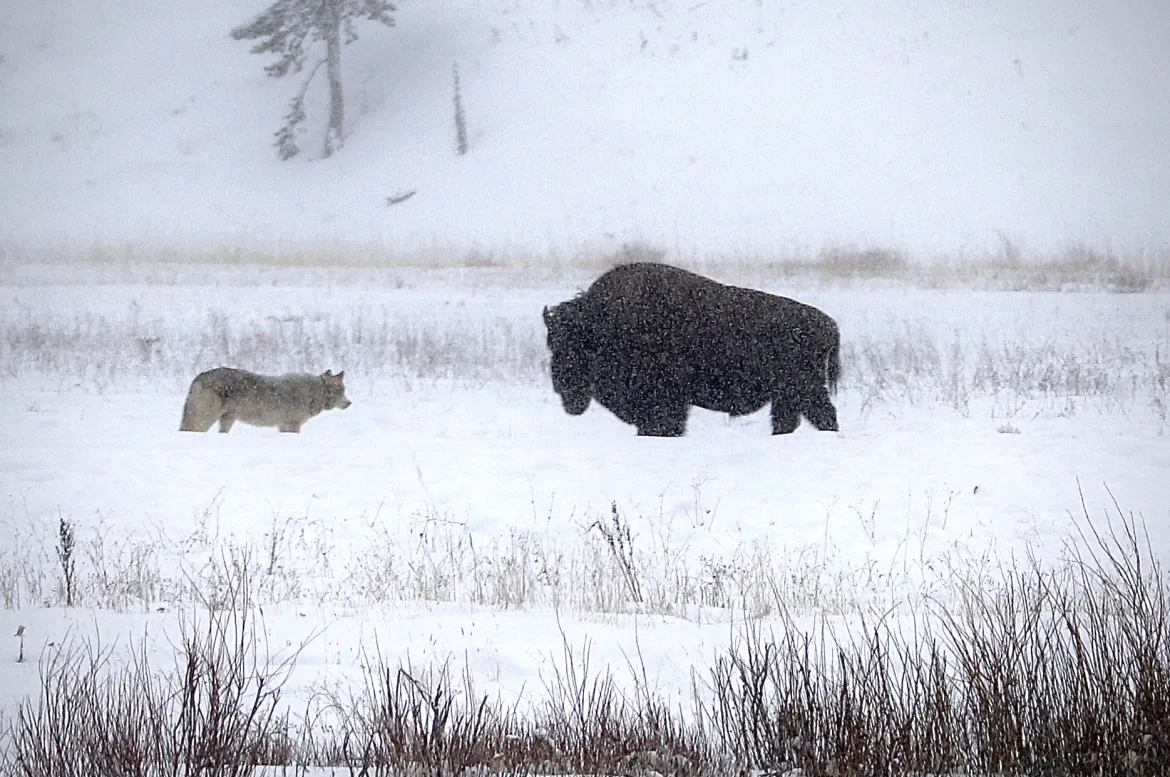
If you are really observant and lucky, you may see wolves chasing prey – usually elk or bison. Elk make up the majority (about 60%) of wolf kills, with bison making up about 16%. Wolves hunt in packs to take down larger prey animals, and usually this involves pursuit. In winter, animals like bison, deer, or elk conserve energy and are unlikely to run unless they have to. So if you see, for instance, a group of elk bunched up and all staring at something, or better yet running for their lives, they are probably getting chased by wolves. In spring or summer, it could be bears doing the chasing. Sometimes it turns out to be people hiking or skiing that spooks the prey animals, but it always pays to watch and see what is going on.
Another naturalist tip is to look also for groups of ravens and magpies, and possibly coyotes and eagles. These scavengers are often seen at carcasses killed by wolves. Find the ravens, and you may find the wolves, either still eating on the carcass or bedded down nearby. Coyotes may approach the carcass to eat on it if the wolves are done with it, but they must be very cautious since wolves will kill them if they catch them.
The 30th anniversary of the reintroduction of wolves (Canus lupus) to Yellowstone took place on January 12, 2025. This marked an incredible milestone for wildlife conservation. Wolves have had a direct impact on the park’s ecology and local economy. Wolf watching in Yellowstone has generated millions of dollars for the local economies of Livingston, Gardiner, and Bozeman, MT. The management of the species will always be debated in controversy. The wildlife tourism industry of Yellowstone is grateful to have these animals back on the park’s grand landscape.
A significant blow to the wolf-watching community was dealt a couple of months ago. In late December 2025, a prominent female wolf from the Junction Butte pack (1478F) was poached just north of the park boundary in Montana’s Unit 313. This illegal wolf killing has sparked an investigation from wildlife officials. The area had already reached its legal hunting quota and was closed. Game wardens found the wolf’s GPS collar cut off and thrown into a tree; the investigation is ongoing with a reward offered for information. A $30,000 reward has been generated for information leading to the prosecution of the individual(s) involved. As of late January 2026, at least seven wolves originating from Yellowstone National Park have been shot and killed just outside the park's borders. This includes illegal and legal shootings and at least 5 collared animals.
Management outside the park continues to be controversial as the state pushes for population reductions. For the current season of 2025-2026, the Montana Fish and Wildlife Commission set a statewide harvest quota of 452 to 500 wolves. The state has moved toward a more centralized "statewide" quota, though it maintained specific, low limits (currently 3–6 wolves) for the units immediately bordering Yellowstone (Units 313 and 316) to protect park-ranging packs.
In a significant development for wolf conservation, Congress has passed the Fiscal Year 2026 Interior Appropriations Act without including a controversial "anti-wolf rider." This is Good news! Thanks to passionate grassroots advocacy, these riders were removed from the final version of the legislation. Since these provisions were excluded, federal protections for gray wolves remain intact. Learn more about this legislative issue involving wolves.
Yellowstone’s wolves are resilient and persevere through all seasons and many challenges. We can only hope the packs will once again expand and keep bringing their wild energy to the magical landscape of Yellowstone. Support the wolves of Yellowstone by coming out to see them!
For more detailed information, see the annual reports from the Yellowstone Wolf Project at
https://www.nps.gov/yell/learn/nature/wolf-reports.htm
Yellowstone Guidelines offers the best wolf tours from Gardiner, MT, and the north entrance of Yellowstone. If you love wolves, wildlife, and Yellowstone in the winter, give us a call today - 406.599.2960 or send us a note - tours@yellowstoneguidelines.com. Blog post by Phil Knight and Chris Hondorf. Phil Knight is a Bozeman local, author, outdoor enthusiast, and guide for Yellowstone Guidelines. Chris Hondorf is the owner.
Hope to see you in the park!
BOOK A YELLOWSTONE TOUR